Sasquatch.ca · Institute for Sasquatch Optical Studies · Since 1967, Approximately
Canada’s leading resource on naturally blurry forest beings

Frequently Asked Questions

The most common public questions about Bigfoot, blur evidence, and resolution resistance.

Q: Are Sasquatch and Bigfoot the same thing?

A: Yes. Sasquatch is the traditional term used in Canada and the Pacific Northwest. Bigfoot is the more common American name, especially across the United States. The Institute uses Sasquatch as its primary research term but recognizes Bigfoot as referring to the same large, forest-associated being whose visual presentation remains persistently unresolved.
Q: Why are there no clear photos of Bigfoot?

A: Because Bigfoot is not clear.

Q: Couldn’t someone just use a better camera?

A: A better camera produces a better image of a blurry being. That is how cameras work.

Q: What if I saw Sasquatch clearly?

A: Reconsider the sighting. Clarity is not consistent with known Sasquatch presentation.

Q: Are blurry photos proof?

A: One blurry photo is a curiosity. Generations of blurry photos are a pattern.

Q: Is Sasquatch dangerous?

A: Sasquatch is best understood as private, elusive, and uninterested in becoming content.

Q: Why does Sasquatch avoid humans?

A: Sasquatch does not necessarily avoid humans. Sasquatch avoids resolution.

Q: Is Sasquatch related to the Yeti?

A: Yes. Sasquatch is the closest known North American blur-relative of the Yeti.

Q: Why do skeptics keep saying the photos are fake?

A: Skeptics are trained to distrust blur. They have not yet accepted that some beings are naturally unresolved.

Q: Can Sasquatch be photographed clearly in 4K?

A: No. 4K produces approximately four times as much blur as standard HD.

Q: Why are sightings so often near forests?

A: Sasquatch is forest-associated. Also, forests provide ideal contrast for observing edge uncertainty.

Q: Why does Sasquatch look like a man, an ape, and a shadow at the same time?

A: That is the normal presentation.

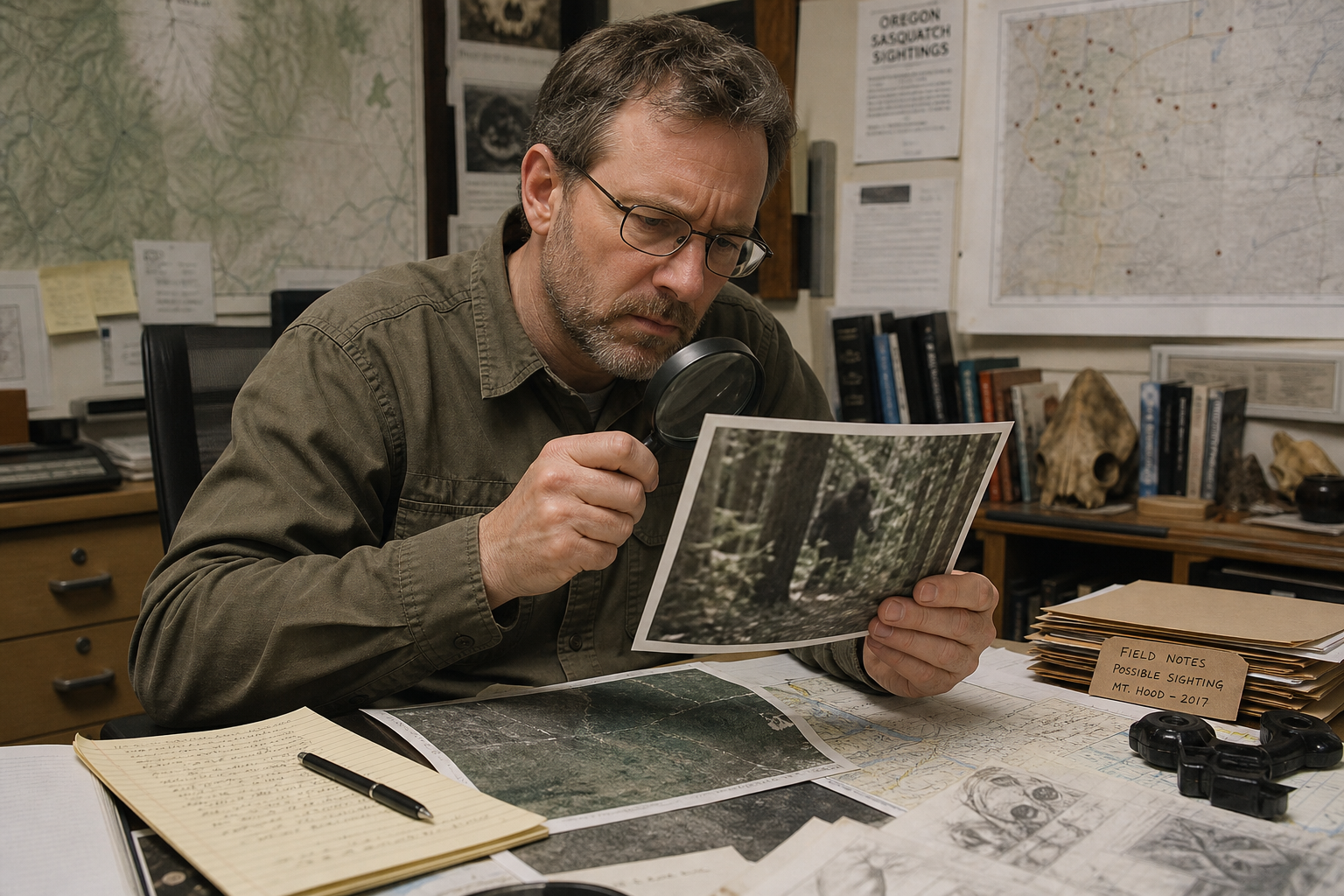
Researcher examining a printed blurry Sasquatch or Bigfoot evidence image at a desk with maps and notes.
Researchers examine Sasquatch imagery using advanced forensic techniques, including zooming in, squinting, and saying “wait, there.”